
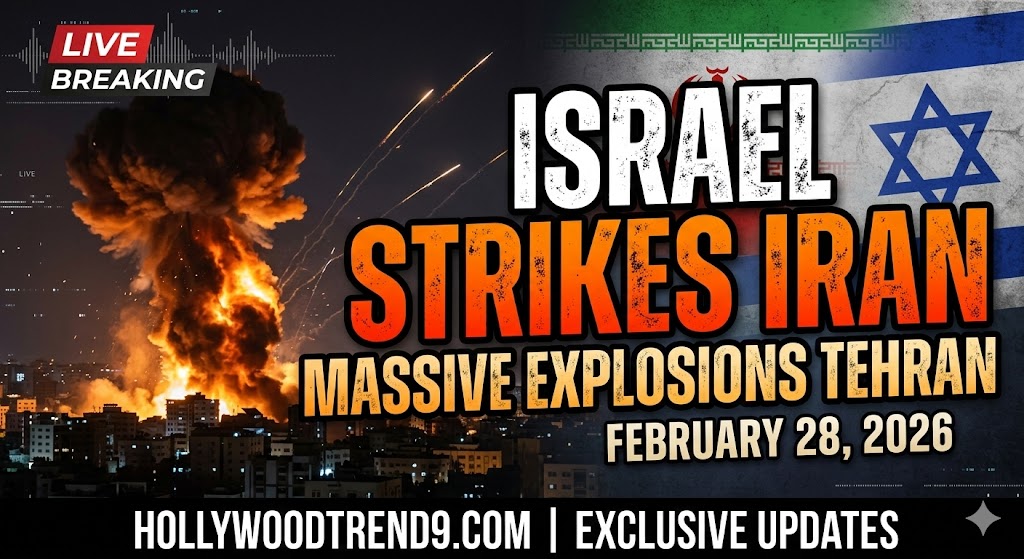
Israel strikes Iran February 28 2026 The geopolitical landscape of the Middle East shifted dramatically in the early hours of February 28, 2026. In a move that has sent shockwaves from Washington D.C. to the global financial markets, Israel officially announced a series of precision military strikes against strategic targets in Iran. As residents of Tehran reported hearing deafening explosions that lit up the night sky, the world now watches with bated breath to see if this “shadow war” has finally evolved into an all-out regional conflict.
For American audiences and the international community, this development represents a critical turning point in international relations, sparking immediate reactions from the White House and global security experts.
The Midnight Strike: What We Know So Far
Facebook Community 🇺🇲
Join our Hollywood & USA news group!
Israel strikes Iran February 28 2026 The first reports of trouble surfaced around 2:00 AM local time when social media began buzzing with grainy footage of anti-aircraft fire over the Iranian capital. Shortly after, the Israel Defense Forces (IDF) took the rare step of immediately claiming responsibility.
According to official statements, the operation was a response to “months of continuous attacks” from the Iranian regime and its regional proxies. The strikes reportedly targeted:
- Military Infrastructure: Key command and control centers located on the outskirts of Tehran.
- Drone Manufacturing Plants: Facilities believed to be producing the UAVs used in various regional conflicts.
- Missile Launch Sites: Strategic locations in Western Iran capable of reaching Israeli territory.
While Iranian state media initially downplayed the “noise,” claiming the sounds were merely the result of air defense systems intercepting “small objects,” the scale of the flashes caught on camera suggests a much more significant kinetic event.
Background: A Long-Standing Shadow War Goes Public
Israel strikes Iran February 28 2026 To understand the weight of today’s news, one must look at the escalating tensions throughout late 2025 and early 2026. The friction between Jerusalem and Tehran has historically been fought through cyberattacks, maritime sabotage, and proxy groups. However, several factors led to this direct confrontation:
1.The Nuclear Threshold: Intelligence reports recently suggested that Iran was closer than ever to weapon-grade uranium enrichment, a “red line” consistently cited by Israeli leadership.
2.Proxy Aggression: Increased activity from groups in Lebanon and Yemen had put immense pressure on the Israeli government to strike the “head of the snake.”
3.Diplomatic Stalemate: Failed attempts at reviving international nuclear agreements left a vacuum that military strategists on both sides were quick to fill.
Global Reactions: The View from Washington and Beyond
Israel strikes Iran February 28 2026 The timing of this strike is particularly sensitive for U.S. foreign policy. In a late-night briefing, the White House Press Secretary stated that the United States was “notified in advance” of the operation but did not participate directly.
U.S. Political Sentiment
In Congress, the reaction has been split along familiar lines. Many lawmakers have voiced unwavering support for Israel’s right to self-defense, while others have expressed grave concerns about the potential for American forces in the region to be pulled into a broader war.
The Oil Market Panic
Within minutes of the explosions in Tehran, global oil prices saw a sharp spike. Analysts warn that if the Strait of Hormuz—a vital artery for the world’s energy supply—is affected by Iranian retaliation, American consumers could see a significant rise in gas prices at the pump within days.
Social Media Reactions: A Digital Battlefield
Israel strikes Iran February 28 2026 As with any modern crisis, the narrative is being shaped in real-time on platforms like X (formerly Twitter) and TikTok.
- #TehranExplosions and #IsraelStrikes have been trending worldwide for hours.
- Citizen Journalism: Videos from Tehran residents show the terrifying reality of the explosions, providing a raw look at the situation that state-controlled media often obscures.
- Misinformation Warning: Security analysts are urging the public to be cautious of “recycled footage” from older conflicts being passed off as current events.
The Humanitarian Perspective: Civilians in the Crosshairs
Israel strikes Iran February 28 2026 Behind the military maneuvers and political rhetoric are millions of civilians living in fear. In Tehran, reports indicate that residents are stocking up on fuel and food, fearing that the initial strikes are just the beginning of a prolonged campaign. International human rights organizations are calling for both sides to exercise maximum restraint to prevent civilian casualties in densely populated urban areas.
Future Outlook: Escalation or Deterrence?
Israel strikes Iran February 28 2026The million-dollar question remains: Will this strike act as a deterrent, or is it the first chapter of a much larger book?
Scenario 1: Controlled Escalation
Iran may choose a symbolic retaliation—a cyberattack or a limited strike via proxies—to save face without triggering a full-scale war that would jeopardize the regime’s survival.
Scenario 2: Regional Contagion
If Iran chooses to respond directly against Israeli cities, the conflict could quickly draw in neighboring countries, potentially forcing a massive military intervention by the United States and its allies.
The Role of the UN
An emergency session of the UN Security Council is expected to be called within the next 24 hours. However, with the current geopolitical rift between permanent members, a unified resolution remains unlikely.
Conclusion: A World on Edge
The explosions in Tehran marked a definitive end to the era of the “Shadow War.” As the sun rises over the Middle East today, the smoke clearing from the outskirts of the Iranian capital reveals a world that is significantly more dangerous than it was 24 hours ago.
At HollywoodTrend9, we usually focus on the glitz and glamour of the entertainment world, but when global events of this magnitude occur, they ripple through every aspect of our lives—from the movies we watch to the safety of the world we live in. We will continue to monitor the situation and provide updates on how these events affect global security and the American landscape.
Stay tuned to HollywoodTrend9.com for the latest updates on this developing story.
Hollywood Leaks 🎬
Get Spoilers & News on WhatsApp

Leo Maverick is a seasoned digital journalist, the founder, and Editor-in-Chief of Hollywood Trend 9 and USA News Buzz 🇺🇸. With a sharp eye for trending stories and a deep passion for American cinema and current affairs, he specializes in providing real-time updates on Hollywood box office, celebrity insights, and major industry shifts. Under his leadership, his platforms have become trusted sources for accurate, high-energy entertainment journalism and breaking news across the United States.